
hpc-ch
  • Facebook
  • Twitter
  • Youtube
  • Rss
The Swiss HPC Service Provider Community
  • Home
    • Calls for Proposals
    • Conferences & Presentations
      • Video of talks
    • Courses & Workshops
      • Video of Courses
    • Job offers
    • Science
    • Technology
    • Video blog
  • About
    • hpc-ch Community News
    • hpc-ch Booth
    • Forums
    • HPC Advisory Council
  • Members Academia
    • [BC]2
    • CHIPP
    • CSCS
    • EMPA
    • EPF Lausanne
    • ETH Zurich
    • PSI – Paul Scherrer Institut
    • Speedup
    • SwiNG
    • SWITCH
    • SystemsX.ch
    • Università d. Svizzera italiana
    • Universität Basel
    • Universität Bern
    • Université de Fribourg
    • Université de Genève
    • Université de Lausanne
    • Universität Zürich
    • Vital-IT
    • WSL
  • Members Industry
    • Casale Group
    • Credit Suisse
    • Hilti
    • MeteoSwiss
    • Novartis
    • PartnerRe
    • Syngenta Crop Protection
  • Contact
Home» Members Academia » CSCS » CSE Lab of ETH Zurich wins the Van Dyke Award: 3D Shock-Bubble Interactions at Mach 3

CSE Lab of ETH Zurich wins the Van Dyke Award: 3D Shock-Bubble Interactions at Mach 3

Posted on January 15, 2013 by mdl in CSCS, ETH Zurich, Science, Video Blog

The Computational Science & Engineering Laboratory (CSE Lab) of ETH Zurich lead by Professor Petros Koumoutsakos wins the Milton Van Dyke Award presented at the 65th Annual  Conference of the Division of Fluid Dynamics of the American Physical Society, November 18-20, 2012, in San Diego, CA.

This award highlights photographs and videos that illustrate both experimental and numerical investigations of a wide variety of flow phenomena. Judged by a distinguished international panel of referees, winning entries were selected based upon criteria of scientific merit, originality, and artistry/aesthetic appeal.

The simulations of shock-bubble interactions were realized on the CSCS supercomputer «Monte Rosa» by Babak Hejazialhosseini, Diego Rossinelli and Petros Koumoutsakos.

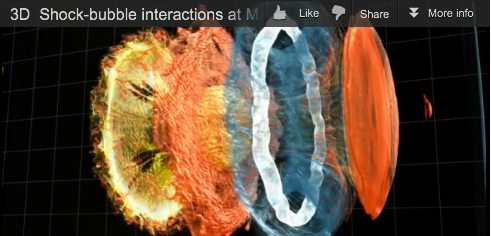
The video shows a computer simulation of a Mach 3 normal shock wave in air that is  directed at a helium bubble. The bubble is compressed as the shock wave passes over it. Vorticity develops on the bubble-air interface and deforms it, then a jet of air shoots out. This sequence of events is followed by the generation of a long-lasting vortical core and finally of a complex mixing zone. The employed software enables simulations with up to 250 billion cells on a supercomputer, and 4 billion cells were used to produce this video.

Bookmark and Share
CSCS, ETH Zurich, Science

Featured video

Discussion between Daniel Duffy and William Putman (NASA): Challenges for global climate simulation

Latest hpc-ch Tweets

  • hpc-ch Forum on HPC in Swiss Industry at Novartis http://t.co/UlAwrTHvEW
    May 22, 2013
  • Slidecast (in Italian): Grid computing and the search for the new particle at CERN by Günther Dissertori, ETH Zurich http://t.co/iNt5eyX74F
    May 16, 2013
  • Special ISC’13 Session to Probe the Thinking behind Europe’s Human Brain Project #epfl http://t.co/k8ZyuQe3dF
    May 13, 2013

Posts by Category

(c) 2013 www.hpc-ch.org