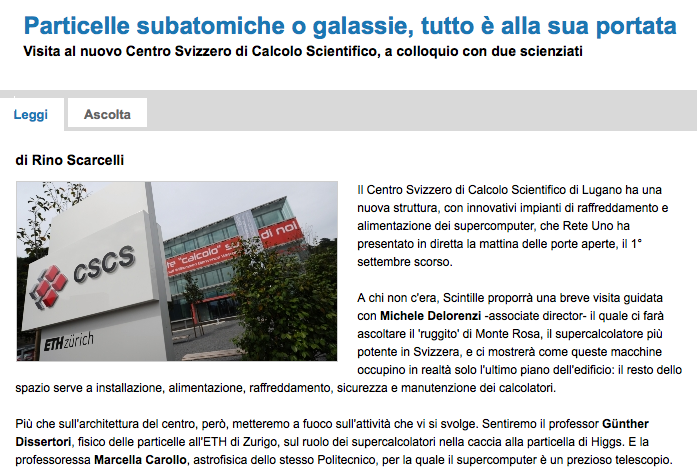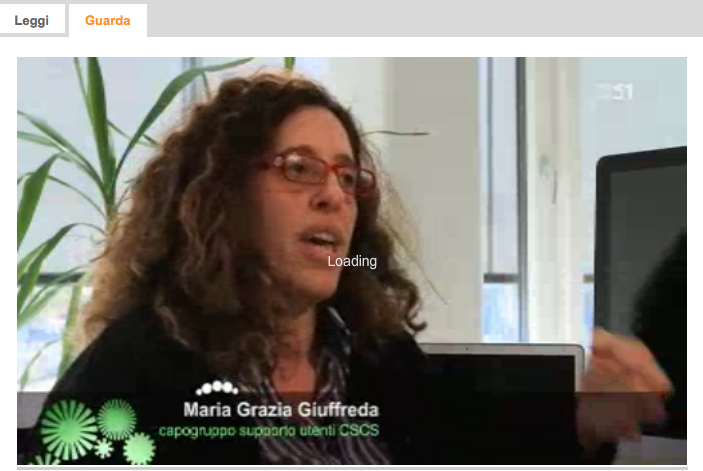
On June 3rd, 2012 the RSI LA1 (Radiotelevisione Svizzera Italiana) broadcasted “Il Giardino di Albert” dedicated to the Nanotechnology (“Nanoparticelle e tecnologia informatica”). During the programme, one slot was reserved to CSCS and its relocation to the new building in Lugano. In the “Supercomputer, supertrasloco”, the ” Il Giardino di Albert” ‘s crew reveals the [...]
Paper from Swiss research institutions is PRACE Award Winner 2012
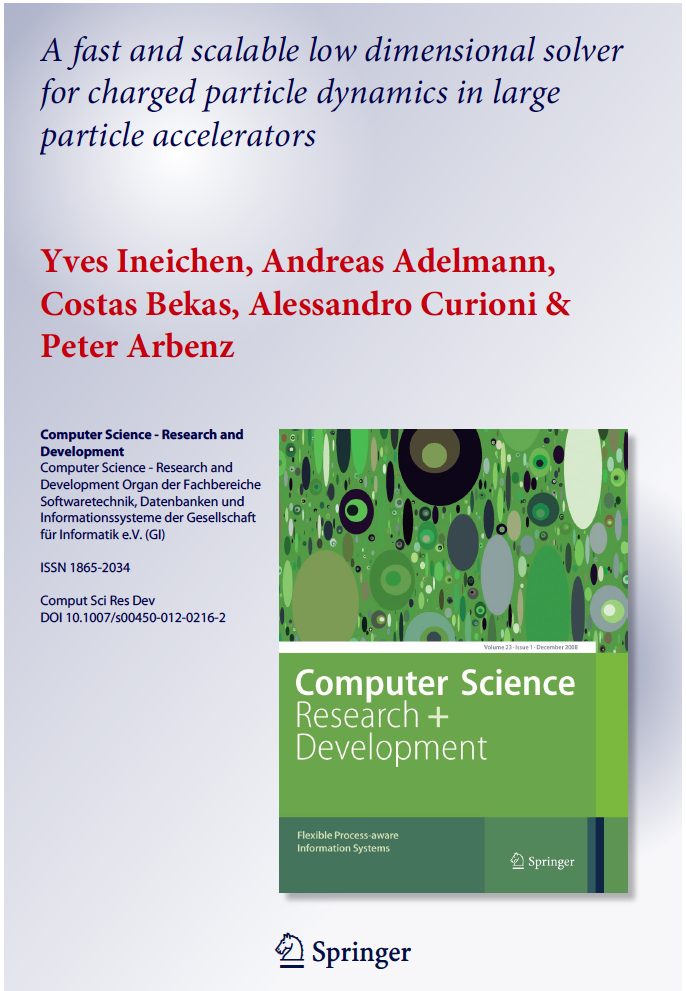
We congratulate Yves Ineichen (Paul Scherrer Institute/IBM Research Zurich), Andreas Adelmann (PSI), Costas Bekas (IBM Ruschlikon), Alessandro Curioni (IBM Ruschlikon) & Peter Arbenz (ETH Zurich) who have won the PRACE Award 2012 for their paper A Fast and Scalable Low Dimensional Solver for Charged Particle Dynamics in Large Particle Accelerators Yves and co-authors will receive the [...]
Interdisciplinary project between CSCS and University of Lugano on Computational Finance funded by Swiss National Science Foundation
Analysis and prediction of financial risks, such as market and credit risks, is one of the central problems in modern economy. An adequate understanding of the available risk data requires advanced mathematics and refined high performance numerical algorithms. A pilot study carried out at the Institute for Computational Science at the University of Lugano (USI) [...]
Escape response of small fish tested using a supercomputer
Small fish bend themselves into a ‘C’ shape before they flee from predators. Observations have suggested that this shape helps them to abruptly put the greatest distance possible between themselves and their predators. Petros Koumoutsakos, a professor at the Computational Science & Engineering Laboratory » at ETH Zurich, and two of his doctoral students, Mattia [...]
Solving the Mystery of Neanderthal Man in the Supercomputer
CSCS is reporting on how supercomputers can explain why Homo neanderthalensis disappeared about 15,000 years ago. At that time modern humans, Homo sapiens, came to Europe and Homo neanderthalensis disappeared for good. Now the supercomputer is to assess which of the current hypotheses can explain their extinction. 20,000 to 200,000 years before our time, with [...]